T6: Electronic and Electrical Components questions (2026–2030 Technician pool)
All 46 questions from subelement T6, Electronic and Electrical Components, with the correct answer marked. Your exam draws one question from each group below, so you'll see 4 T6 questions. On test day the answer order can be shuffled, so learn the answer, not the letter. Tap "Why" for a plain-English explanation.
T6A (11 questions, 1 on your exam)
- A. Inductor
- B. Resistor ✓
- C. Inverter
- D. Transformer
Why, and a memory hook
A resistor opposes the flow of current in a DC circuit.
Memory hook: Resistor resists.
- A. Fixed resistor
- B. Power resistor
- C. Potentiometer ✓
- D. Transformer
Why, and a memory hook
A potentiometer is a variable resistor commonly used as an adjustable volume control.
Memory hook: Pot = volume knob.
- A. Inductance
- B. Resistance ✓
- C. Capacitance
- D. Field strength
Why, and a memory hook
A potentiometer controls resistance.
Memory hook: Pot varies resistance.
- A. Resistor
- B. Capacitor ✓
- C. Inductor
- D. Diode
Why, and a memory hook
A capacitor stores energy in an electric field.
Memory hook: Capacitor = electric field.
- A. Resistor
- B. Potentiometer
- C. Oscillator
- D. Capacitor ✓
Why, and a memory hook
A capacitor consists of conductive surfaces (plates) separated by an insulator (dielectric).
Memory hook: Plates plus insulator.
- A. Resistor
- B. Capacitor
- C. Inductor ✓
- D. Diode
Why, and a memory hook
An inductor stores energy in a magnetic field.
Memory hook: Inductor = magnetic field.
- A. Transistor
- B. Capacitor
- C. Diode
- D. Inductor ✓
Why, and a memory hook
An inductor is typically built as a coil of wire.
Memory hook: Coil = inductor.
- A. A single circuit is opened or closed
- B. Two circuits are opened or closed
- C. A single circuit is switched between one of two other circuits ✓
- D. Two circuits are each switched between one of two other circuits
Why, and a memory hook
An SPDT (single-pole, double-throw) switch connects one circuit to either of two other circuits.
Memory hook: Single pole, two throws.
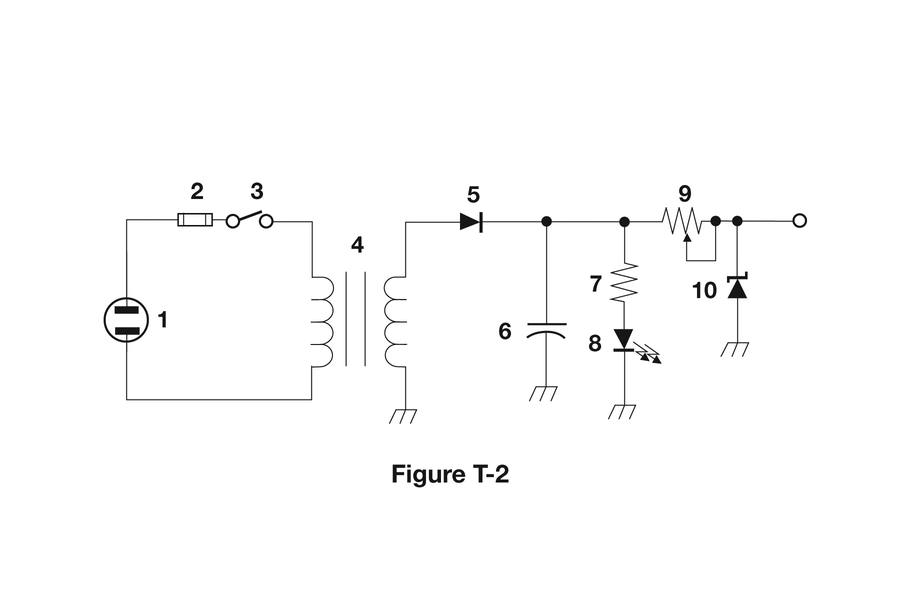
- A. Single-pole single-throw ✓
- B. Single-pole double-throw
- C. Double-pole single-throw
- D. Double-pole double-throw
Why, and a memory hook
Component 3 in figure T-2 is drawn as a simple on/off switch with one pole and one contact, which is single-pole single-throw (SPST).
Memory hook: One pole, one throw: simple on/off.
- A. Nickel-metal hydride
- B. Lithium-ion
- C. Lead-acid
- D. All these choices are correct ✓
Why, and a memory hook
Nickel-metal hydride, lithium-ion and nickel-cadmium batteries are all rechargeable, so every listed rechargeable chemistry qualifies.
Memory hook: NiMH, Li-ion, NiCd recharge.
- A. Nickel-cadmium
- B. Carbon-zinc ✓
- C. Lead-acid
- D. Lithium-ion
Why, and a memory hook
Carbon-zinc batteries are primary cells and are not rechargeable.
Memory hook: Carbon-zinc is one and done.
T6B (12 questions, 1 on your exam)
- A. It is lower in some diode types than in others ✓
- B. It is proportional to peak inverse voltage
- C. It indicates that the diode is defective
- D. It has no impact on the voltage delivered to the load
Why, and a memory hook
Forward voltage drop varies by diode type. For example, Schottky and germanium diodes drop less than silicon diodes.
Memory hook: Schottky drops less than silicon.
- A. Resistor
- B. Fuse
- C. Diode ✓
- D. Driven element
Why, and a memory hook
A diode allows current to flow in only one direction.
Memory hook: Diode = one-way valve.
- A. Varistor
- B. Potentiometer
- C. Transistor ✓
- D. Thermistor
Why, and a memory hook
A transistor can be used as an electronic switch, turning current on and off with a small control signal.
Memory hook: Transistor = electronic switch.
- A. Alternator
- B. Transistor ✓
- C. Triode
- D. Pentode
Why, and a memory hook
A bipolar transistor has three regions of semiconductor material (NPN or PNP).
Memory hook: Three layers, transistor.
- A. Varistor
- B. Field-effect ✓
- C. Hall-effect
- D. Bipolar junction
Why, and a memory hook
A field-effect transistor (FET) has a gate, drain and source.
Memory hook: FET: gate, drain, source.
- A. With the word "cathode"
- B. With a stripe ✓
- C. With the letter C
- D. With the letter K
Why, and a memory hook
The cathode lead of a diode is usually marked with a stripe or band on the package.
Memory hook: Stripe marks the cathode.
- A. Forward current ✓
- B. Reverse current
- C. Capacitively-coupled RF signal
- D. Inductively-coupled RF signal
Why, and a memory hook
An LED emits light when forward current flows through it.
Memory hook: Forward current lights the LED.
- A. Frequency Emission Transmitter
- B. Fast Electron Transistor
- C. Free Electron Transmitter
- D. Field Effect Transistor ✓
Why, and a memory hook
FET stands for Field Effect Transistor.
Memory hook: FET = Field Effect Transistor.
- A. Plus and minus
- B. Source and drain
- C. Anode and cathode ✓
- D. Gate and base
Why, and a memory hook
A diode's electrodes are the anode and the cathode.
Memory hook: Anode in, cathode out.
- A. Transformer
- B. Transistor ✓
- C. Reactor
- D. Resistor
Why, and a memory hook
A transistor can provide power gain, as it controls a larger output power with a small input signal.
Memory hook: Transistors amplify.
- A. The output signal voltage relative to the input signal voltage
- B. The output signal current relative to the input signal current
- C. The output signal power relative to the input signal power
- D. All these choices are correct ✓
Why, and a memory hook
Gain describes how much an amplifier increases the signal. It may refer to the increase in power, voltage or current, so all the listed choices apply.
Memory hook: Gain = how much bigger the signal gets.
- A. Signal, bias, power
- B. Emitter, base, collector ✓
- C. Input, output, supply
- D. Pole one, pole two, output
Why, and a memory hook
The electrodes of a bipolar junction transistor are the emitter, base and collector.
Memory hook: Emitter, base, collector.
T6C (12 questions, 1 on your exam)
- A. Connection chart
- B. Instrumentation system
- C. Schematic ✓
- D. Flow chart
Why, and a memory hook
An electrical diagram drawn with standard component symbols is a schematic.
Memory hook: Schematic = symbol map.
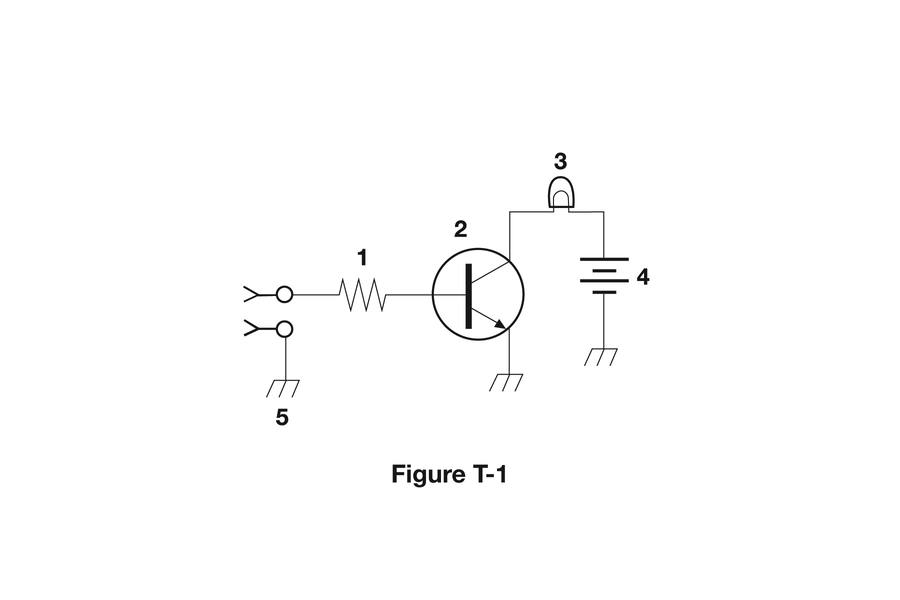
- A. Resistor ✓
- B. Transistor
- C. Battery
- D. Connector
Why, and a memory hook
Component 1 in figure T-1 is drawn with the zigzag symbol for a resistor.
Memory hook: Zigzag line = resistor.
- A. Resistor
- B. Transistor ✓
- C. Indicator lamp
- D. Connector
Why, and a memory hook
Component 2 in figure T-1 is drawn with the three-lead symbol for a transistor.
Memory hook: Three leads and an arrow: transistor.
- A. Resistor
- B. Transistor
- C. Lamp ✓
- D. Ground symbol
Why, and a memory hook
Component 3 in figure T-1 is drawn with a circle containing a loop or an X, the symbol for a lamp.
Memory hook: Circle with a filament: lamp.
- A. Resistor
- B. Transistor
- C. Ground symbol
- D. Battery ✓
Why, and a memory hook
Component 4 in figure T-1 is drawn with long and short parallel lines, the symbol for a battery.
Memory hook: Long and short plates: battery.
- A. Resistor
- B. Capacitor ✓
- C. Regulator IC
- D. Transistor
Why, and a memory hook
Component 6 in figure T-2 is drawn with two parallel plates, the symbol for a capacitor.
Memory hook: Two plates = capacitor.
- A. Resistor
- B. Inductor
- C. Regulator IC
- D. Light emitting diode ✓
Why, and a memory hook
Component 8 in figure T-2 is a diode symbol with arrows pointing away, the symbol for a light emitting diode (LED).
Memory hook: Diode with light arrows = LED.
- A. Variable capacitor
- B. Variable inductor
- C. Variable resistor ✓
- D. Variable transformer
Why, and a memory hook
Component 9 in figure T-2 is a resistor symbol with an arrow across it, the symbol for a variable resistor.
Memory hook: Resistor with an arrow = variable.
- A. Variable inductor
- B. Double-pole switch
- C. Potentiometer
- D. Transformer ✓
Why, and a memory hook
Component 4 in figure T-2 is drawn as two coils side by side, the symbol for a transformer.
Memory hook: Two coils = transformer.
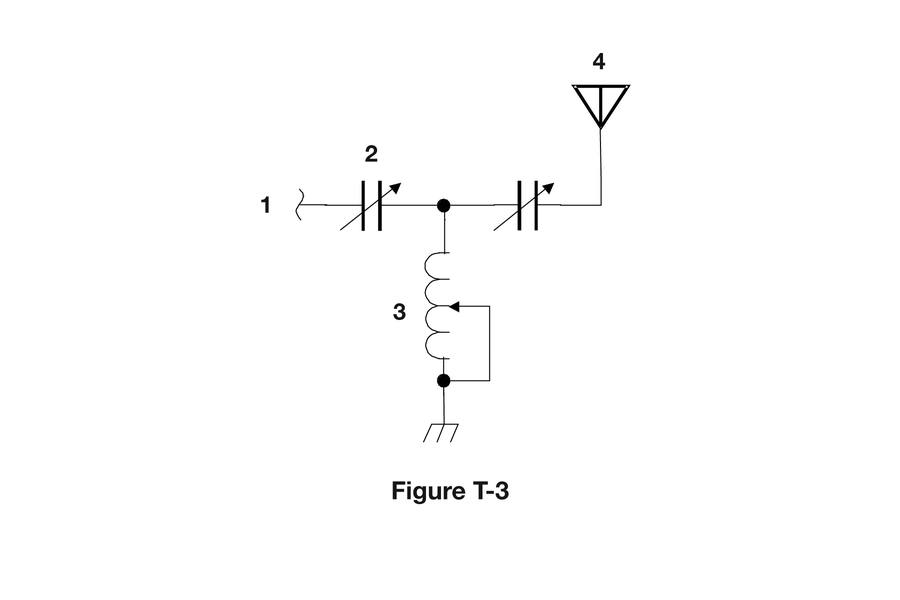
- A. Connector
- B. Meter
- C. Variable capacitor
- D. Variable inductor ✓
Why, and a memory hook
Component 3 in figure T-3 is a coil symbol with an arrow through it, the symbol for a variable inductor.
Memory hook: Coil with arrow = variable inductor.
- A. Antenna ✓
- B. Transmitter
- C. Dummy load
- D. Ground
Why, and a memory hook
Component 4 in figure T-3 is the antenna symbol, a vertical line ending in a fork.
Memory hook: Y-shaped symbol = antenna.
- A. Wire lengths
- B. Physical appearance of components
- C. Component connections ✓
- D. All these choices are correct
Why, and a memory hook
Schematics show how components are connected, but not their physical size, shape or placement.
Memory hook: Schematics show connections.
T6D (11 questions, 1 on your exam)
- A. Transformer
- B. Rectifier ✓
- C. Amplifier
- D. Reflector
Why, and a memory hook
A rectifier changes alternating current into a varying direct current signal. Filters and regulators then smooth it.
Memory hook: Rectifier = AC to DC.
- A. An electrically-controlled switch ✓
- B. A current-controlled amplifier
- C. An inverting amplifier
- D. A pass transistor
Why, and a memory hook
A relay is an electrically controlled switch: a current in its coil moves the contacts.
Memory hook: Relay = remote switch.
- A. To decrease the resistance of DC power connections
- B. To increase the current carrying capability of the wire
- C. To prevent coupling of unwanted signals to or from the wire ✓
- D. To reduce receiver overload
Why, and a memory hook
Shielded wire prevents unwanted signals from coupling into or out of the wire.
Memory hook: Shield keeps signals in or out.
- A. Potentiometer
- B. Transistor
- C. Meter ✓
- D. Relay
Why, and a memory hook
A meter displays an electrical quantity as a numeric value.
Memory hook: Meter measures and shows a number.
- A. Regulator ✓
- B. Oscillator
- C. Filter
- D. Phase inverter
Why, and a memory hook
A regulator circuit controls the voltage from a power supply.
Memory hook: Regulator holds the voltage.
- A. Variable capacitor
- B. Transformer ✓
- C. Transistor
- D. Diode
Why, and a memory hook
A transformer changes 120 V AC to a lower AC voltage.
Memory hook: Transformers step voltage.
- A. LED ✓
- B. FET
- C. Zener diode
- D. All these choices are correct
Why, and a memory hook
An LED is commonly used as a visual indicator.
Memory hook: LED = indicator light.
- A. Resistor
- B. Zener diode
- C. Potentiometer
- D. Capacitor ✓
Why, and a memory hook
A capacitor combined with an inductor forms a resonant circuit.
Memory hook: L plus C resonates.
- A. Transducer
- B. Multi-pole relay
- C. Integrated circuit ✓
- D. Transformer
Why, and a memory hook
An integrated circuit (IC) combines several semiconductors and other components in one package.
Memory hook: IC = whole circuit in a chip.
- A. Give off light when current flows through it
- B. Supply electrical energy
- C. Control the flow of current ✓
- D. Convert electrical energy into radio waves
Why, and a memory hook
Component 2 in figure T-1 is a transistor, which controls the flow of current.
Memory hook: Transistor = current valve.
- A. An inductor and a capacitor in series or parallel ✓
- B. A linear voltage regulator
- C. A resistor circuit used for reducing standing wave ratio
- D. A circuit designed to provide high-fidelity audio
Why, and a memory hook
A resonant (tuned) circuit consists of an inductor and a capacitor connected in series or in parallel.
Memory hook: LC pair makes a tuned circuit.
Test yourself on these
Take a free 35-question practice exam drawn one per group, just like the real thing.
Start the free practice test← T5: Electrical PrinciplesAll subelementsT7: Practical Circuits →